USC's prices have changed over the last 10 years. Have their offerings kept up?
A decade of USC budget documents tells a story the administration would rather not headline. Tuition stayed flat for in-state students, sure, but everything else crept up — and nobody asked permission.
By Common Sense Carolina | Feb 12, 2026 | 9 min read
Go look at your bursar bill from this semester. Not just the tuition line. Scroll down. Housing. Meal plan. Parking. Athletics auxiliary fee. That last one is new, by the way, and if you missed it, you are not alone.
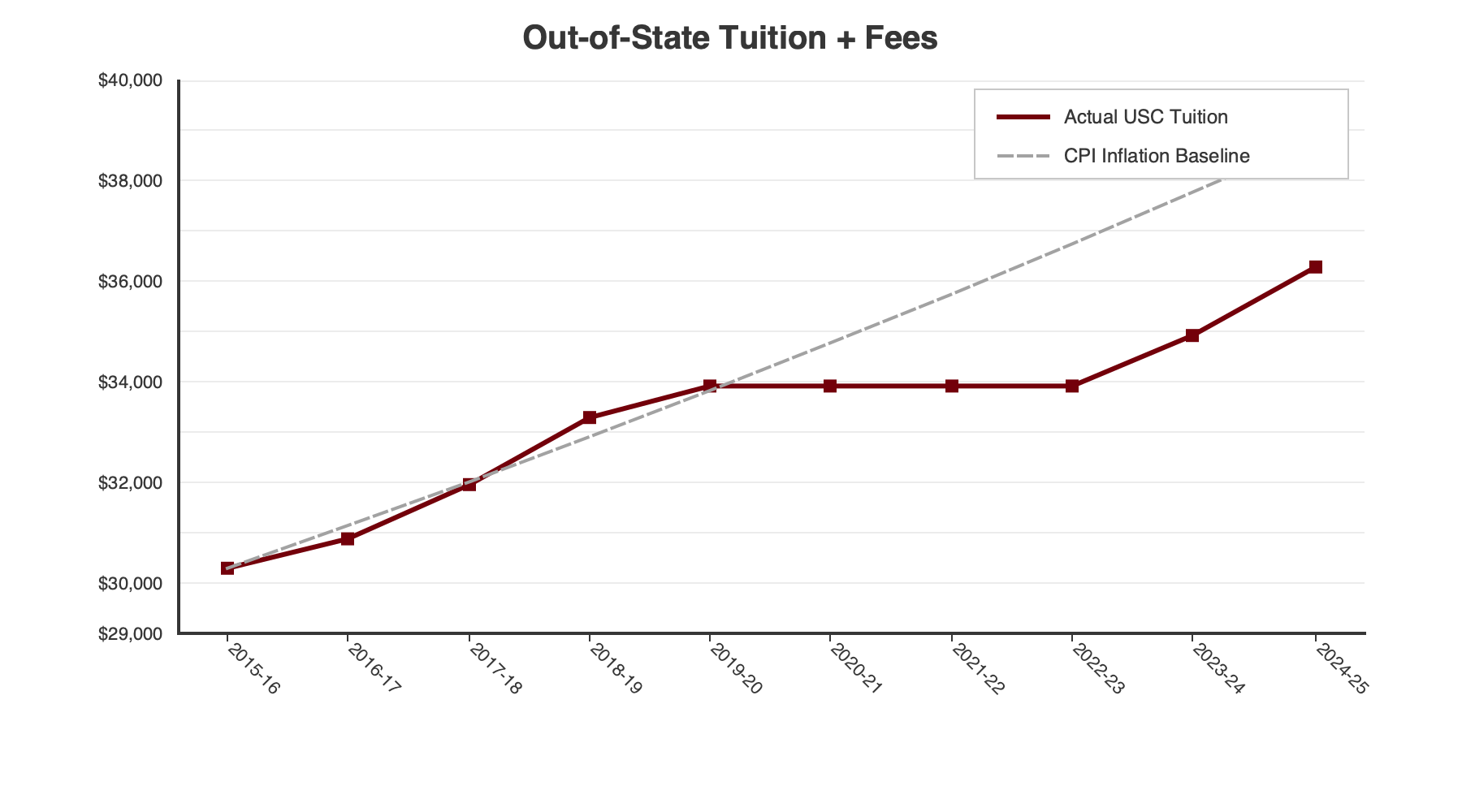
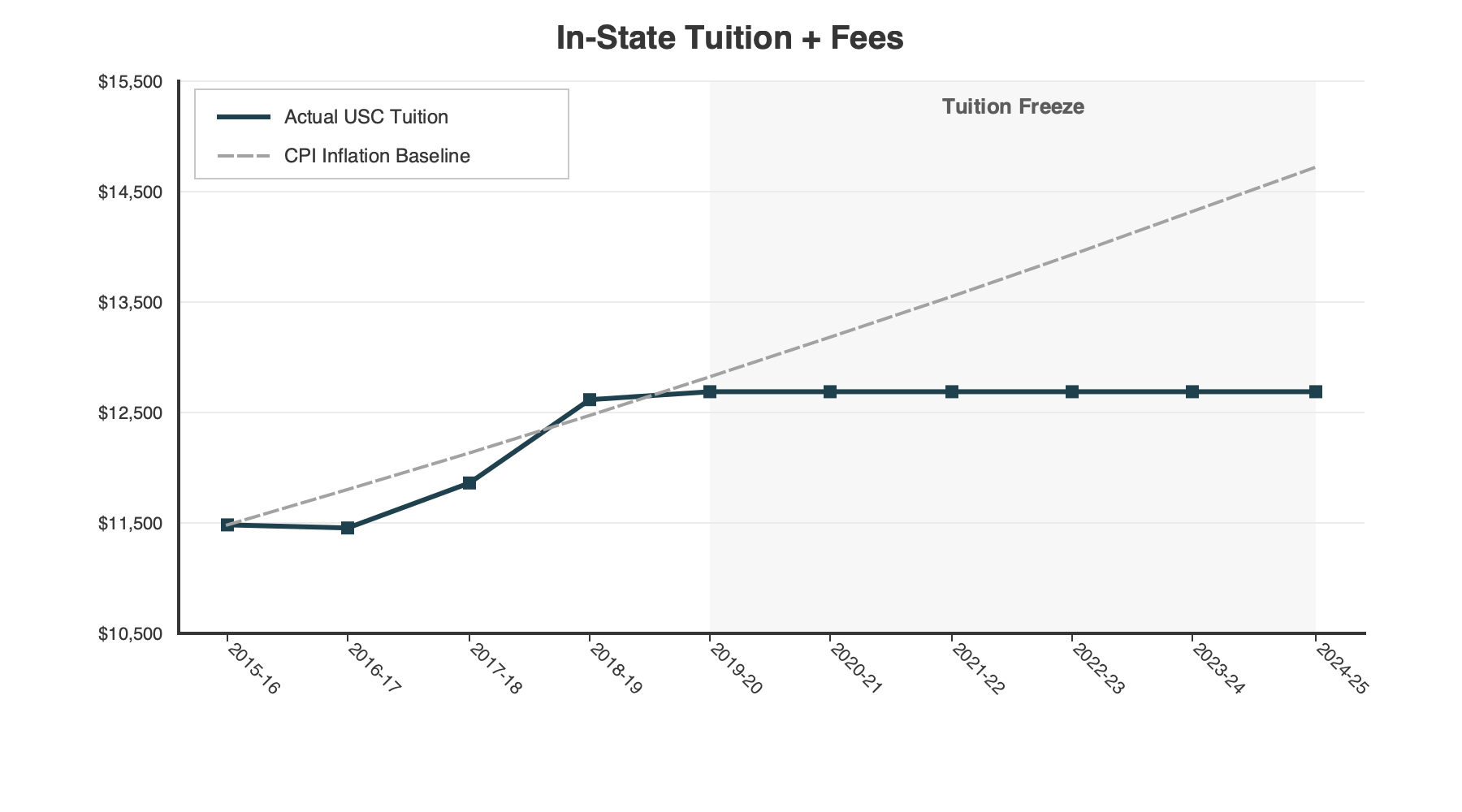
USC has spent the better part of a decade telling families that tuition is under control. And for in-state students, that is technically true. In-state tuition has not increased since 2019, and the university loves to say so (Post and Courier, June 2024). But the sticker price of attending this school has gone up anyway, and it has gone up a lot, because tuition is not the only thing students pay for.
We pulled USC’s own budget documents from FY2016 and FY2026 (FY2016 budget, FY2026 budget). The numbers are not adjusted for inflation. They do not need to be adjusted to make the point, but we will get to inflation in a minute.
The table
| Category | 2015-16 | 2025-26 | Change |
|---|---|---|---|
| Total annual cost (out-of-state, on-campus) | — | $64,052 | — |
| Tuition + required fees (out-of-state, annual) | $30,298 | $37,688 | +$7,390 (+24.4%) |
| Housing (average university housing, per semester) | $3,242 | $4,773 | +$1,531 (+47.2%) |
| Mandatory meal plan (per semester) | $1,352 | $2,628 | +$1,276 (+94.4%) |
| Parking, baseline annual permit | $110 (2017) | $125 commuter / $150 resident | +13.6% / +36.4% |
| Parking, garage permit (per semester) | $400 (2017) | $440 | +$40 (+10.0%) |
| Parking, Greek Village permit (per semester) | $260 (2017) | $300 | +$40 (+15.4%) |
| Athletics auxiliary fee (annual) | Did not exist | $300 | New charge |
Tuition and fee totals from USC’s statewide comparison tables in FY2016 and FY2026 budget documents. Housing and meal plan values from USC Columbia undergraduate cost-of-attendance tables. Parking from USC’s archived 2017 permits page and current 2025-26 fee schedule. Total COA from USC Financial Aid’s published 2025-26 nonresident estimate. Percent changes calculated as (new - old) / old. Figures are nominal.
Read that meal plan line again. Almost double. For the same Russell House.
What inflation actually looks like
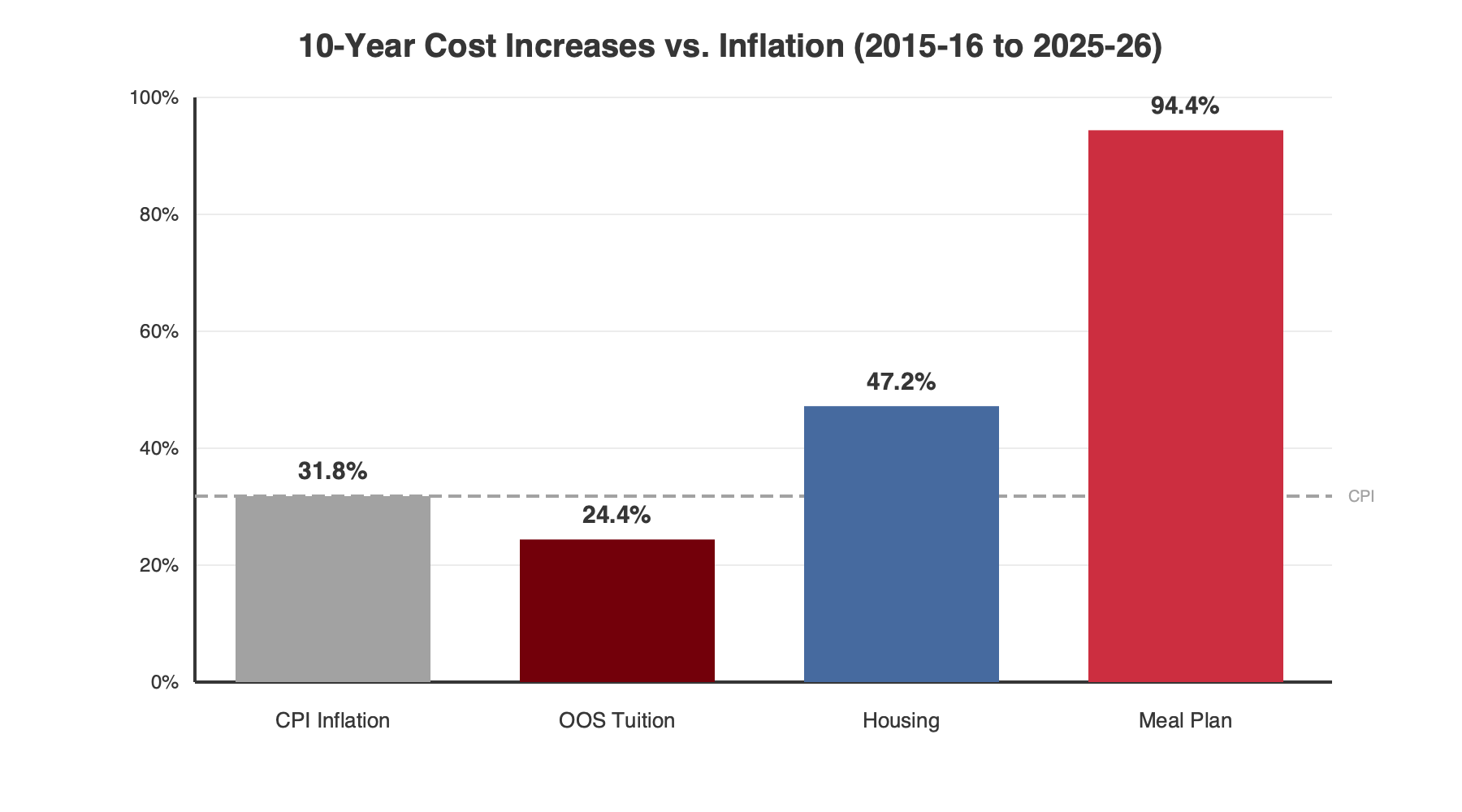
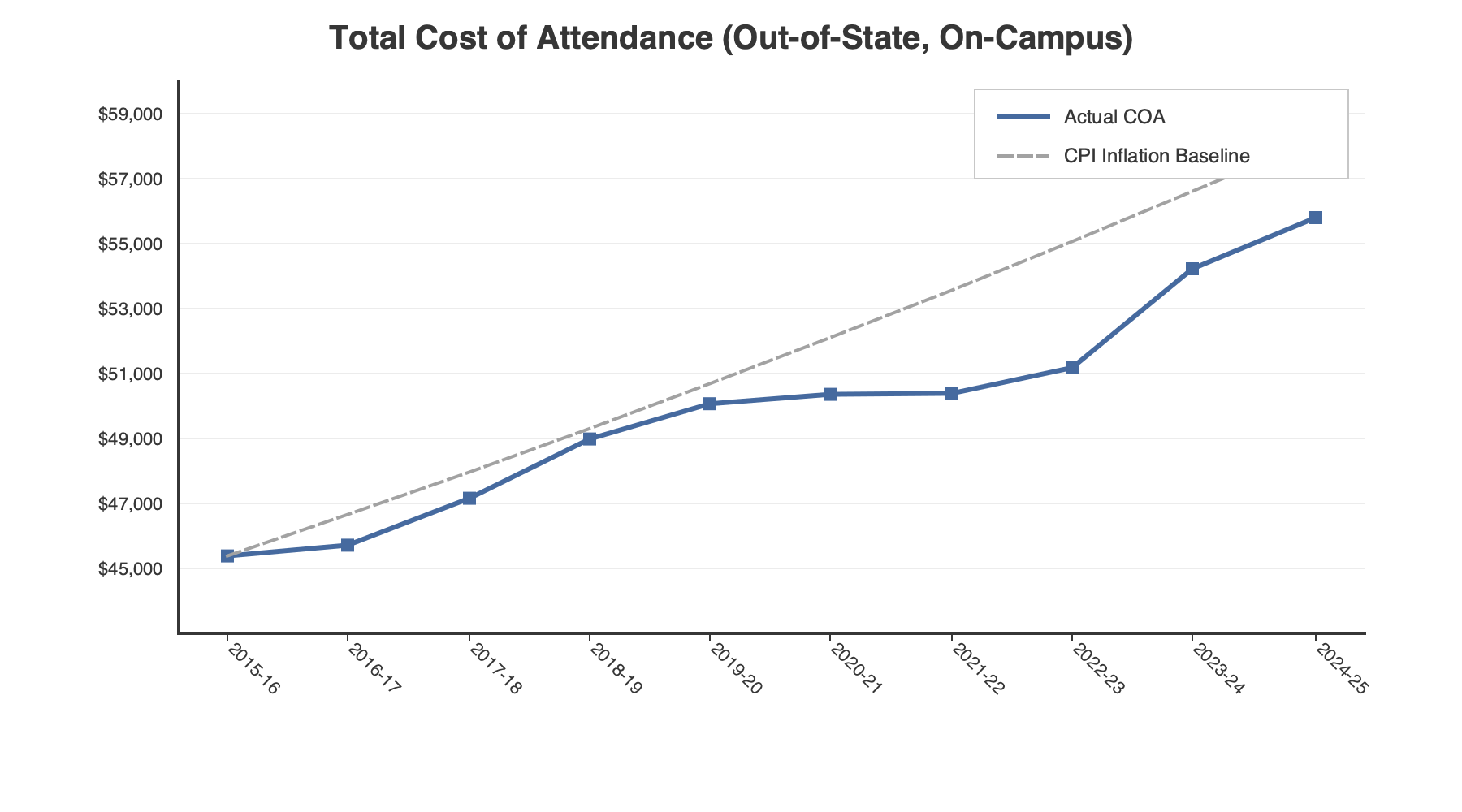
Between 2015 and 2025, cumulative inflation in the United States ran about 31.8 percent, according to Bureau of Labor Statistics CPI data (BLS Inflation Calculator). That is the baseline. If USC had simply raised costs in line with the general economy, a $1,352 meal plan would cost roughly $1,782 today. Instead it costs $2,628. Housing would be about $4,273. Instead it is $4,773. Out-of-state tuition actually grew slower than inflation at 24.4 percent, and the administration deserves credit for that. But housing outpaced inflation by a wide margin, and food nearly tripled the rate.
The university will tell you these increases were modest. The FY2026 budget describes a $233-per-semester housing increase and a $96-per-semester meal plan increase as the “smallest increase for these fees in five years” (USC trustees approve 2026 budget, June 2025). That framing only works if you forget what the starting price already was.
The meal plan problem
The Daily Gamecock surveyed more than 40 students in 2024 and found that 85 percent of them felt campus dining was too expensive (Daily Gamecock, March 2024). Forty-six percent said they lacked affordable, healthy options outside the dining halls. The cheapest mandatory meal plan runs $2,404 per semester, which works out to somewhere between $480 and $601 a month depending on how you count it. Walking into a dining hall for lunch or dinner costs $15.40 at the door if you do not have a swipe.
Think about that for a second. A student paying $2,404 a semester for a plan that maxes out at seven swipes per week is spending roughly $10.50 per swipe. The walk-in rate is $15.40. The economics do not reward you for buying in. They just punish you slightly less.
Meanwhile, 80 percent of students surveyed said they wanted more affordable food options on campus (Daily Gamecock, March 2024). The response so far has not been to lower prices.
Housing that costs more but does not feel like more
Janae Freshley, a Park Place resident, told the Daily Gamecock in 2024 that she found her housing “expensive, very expensive,” adding that “this was our only choice as upperclassmen” (Daily Gamecock, April 2024). Tia Funderburk, also at Park Place, said she “didn’t really have a lot of options” and ended up choosing between Park Place and East Quad. Veronica Graham, a 650 Lincoln resident, was blunter. “I can’t even find a place to live next year on campus,” she said. “I have to find off-campus housing.”
That is not a supply problem the university is unaware of. 650 Lincoln is being converted to house honors and first-year students, which pushes upperclassmen out. Park Place charges between $6,020 and $6,955 per semester. Some of those residents told the Gamecock they had never once used the building’s movie theater or pool, amenities that presumably factor into the price.
Off-campus rent in Columbia averages somewhere between $1,085 and $1,444 a month for a one-bedroom apartment. That is cheaper than what USC charges per month for a dorm room. The difference is that off-campus landlords are not also charging you a mandatory meal plan on top of it.
Parking and the illusion of access
USC sold roughly 21,000 parking permits for fall 2024. The campus has about 17,000 parking spaces (Daily Gamecock, April 2025). You do not need a math degree to see the problem.
Commuter permits run $440 a year. Overflow garage parking costs $1.50 an hour. A full-year deck pass is $880. Citations are $25 each. Rodrigo Rojas, a USC student, called the price increases “just another money grab” in a Daily Gamecock column. “If we could afford an $800-a-year parking pass,” he said, “then we wouldn’t be worrying about this.”
Parking and Transportation Services has described its increases as reflecting “inflationary costs” and an effort to “create an equitable system.” The department is entirely self-funded, meaning it receives no money from tuition or state appropriations. That also means every dollar it collects comes directly from students and employees who drive to campus. When parking gets more expensive, it hits commuters hardest, and commuters tend to be the students who already live farther from campus because they cannot afford to live closer.
The $300 fee nobody voted on
In June 2025, USC’s Board of Trustees approved a new annual $300 athletics auxiliary fee for every undergraduate student (USC trustees approve 2026 budget, June 2025). This was on top of the existing $104-to-$172 student ticket fee. So the total annual cost of attending games that were once marketed as “free” for students is now north of $400 (Daily Gamecock, October 2025).
The fee arrived on bursar bills in the fall. Multiple students told the Daily Gamecock they had no idea what it was. Jaime Letofsky, a third-year finance student, called the bursar’s office to ask. Thomas Sitnik, a first-year computer science student, said he and his mother were confused when they saw it on the bill (Daily Gamecock, September 2025).
Scout Varvel, a first-year theatre student, put it simply. “I don’t think it’s really necessary, especially since we have to pay thousands and thousands of dollars to go here.”
Caroline Orr, a third-year exercise science student, raised a question that a lot of students seem to be thinking. “It would be really nice just to see some of the arts programs get the same level of benefits that athletics does.”
There are more than 650 student organizations at USC. Most of them fundraise on their own. None of them have a mandatory fee attached to every student’s bill.
Meanwhile, $350 million for the stadium
In August 2025, the university received final approval for a $350 million renovation of Williams-Brice Stadium (SC Daily Gazette, August 2025). The athletics department will issue bonds to cover the cost and pay them back over 30 years using revenue from new premium seating and suites. The administration has said that student fees and tuition will not increase as a result of this project.
That may be technically accurate. But the timing tells its own story. The same year USC introduced a brand-new mandatory athletics fee for students, it also greenlit a third-of-a-billion-dollar stadium upgrade funded by luxury box revenue. The message is not subtle. Students pay more to get in the door. Donors and suite holders get a new building.
Construction is expected to begin in December 2025 and wrap up by August 2028. The project includes upgrades to the student section, which is a reasonable thing to spend money on. It also includes nine different club areas, including one at field level, and expanded suites for high-dollar donors. That is who the $350 million is really for.
So what does this add up to?
A student entering USC as an out-of-state freshman in fall 2025 is looking at a published cost of attendance around $64,052 per year (USC Financial Aid). That is not a misprint. Four years of that, assuming zero increases, is $256,208. There will be increases.
An in-state student will pay less, but the non-tuition costs are the same for everyone. Housing, food, parking, and fees do not care what state you are from.
The university’s total budget is $2.1 billion (FY2026 budget). The parking department is self-funded. The athletics department is issuing its own bonds. Student Government gets a modest allocation. And somehow, the costs that students actually feel in their daily lives, eating, sleeping, parking, and watching football, are the ones that keep going up.
USC is not unique in this. Colleges across the country have figured out that freezing tuition makes a great headline while quietly raising everything else keeps the revenue flowing. But at some point, students and families start doing the math. And the math says that a “tuition freeze” does not mean your bill is frozen.
It means the increase is hiding somewhere else on the invoice.